


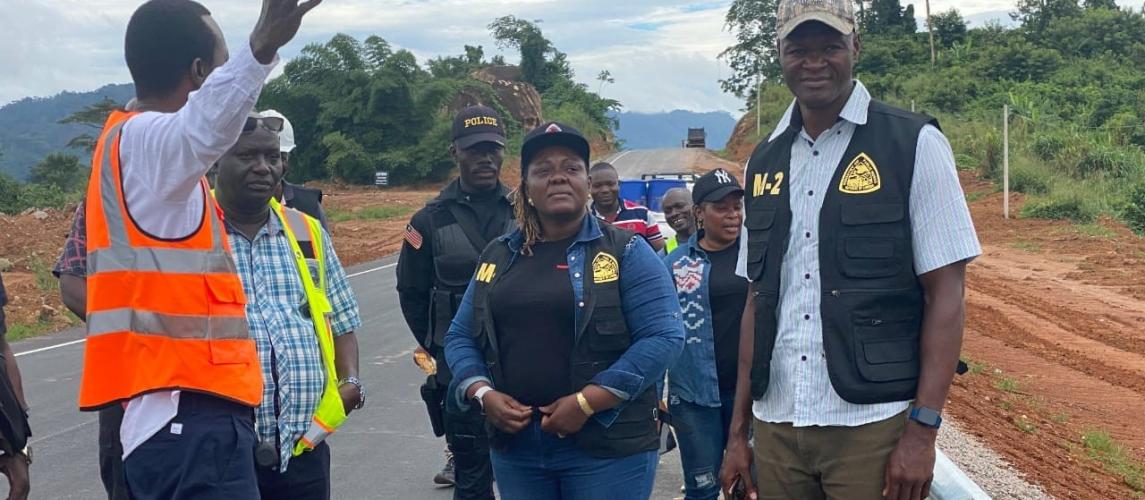
A public dispute over Liberia’s road infrastructure program has escalated, as former Public Works Minister Ruth Coker-Collins forcefully challenged allegations made by current Minister Roland Giddings, insisting that “facts, not fiction,” laid the foundation for the Zwedru Road Corridor.
The controversy centers on claims that road management under the CDC-led administration was poorly executed, allegedly leading to setbacks in international financing and project implementation. Coker-Collins, however, describes those assertions as politically convenient narratives that ignore documented technical progress.
Infrastructure as Policy, Not Politics
Speaking in a recent media appearance, Coker-Collins rejected suggestions that the previous administration mishandled the road sector. She argued that during her tenure, the Ministry pursued structured, engineering-driven planning that advanced key corridors across the country.
Among the flagship initiatives she cited were the Ganta–Zwedru Road, Karluo–Fish Town Road, and Ganta–Logato corridor. She also referenced ongoing works prior to the 2020 transition, including the Gbarnga–Voinjama City corridor and the Freeport–Bambagelia Highway connecting Grand Cape Mount and Bomi Counties.
According to her, these projects were not rhetorical promises but structured programs backed by feasibility studies, procurement processes, and financing frameworks.
“Infrastructure development follows process,” she emphasized. “Design, feasibility, procurement, and financing must align before construction begins.”
The Zwedru Corridor Debate
The most contentious issue concerns the Monrovia–Zwedru corridor. Coker-Collins criticized the current government’s portrayal of the project as a recent initiative, describing that characterization as technically inaccurate.
Under her leadership, she explained, the corridor was divided into three engineering contract lots to ensure phased execution and financial oversight: Ganta to Saclepea, Saclepea to Tapita and Tapita to Toe Town.
She further disclosed that financing for the Toe Town to Zwedru segment had been secured before the government transition in 2020. In her assessment, current construction activities represent continuity rather than reinvention.
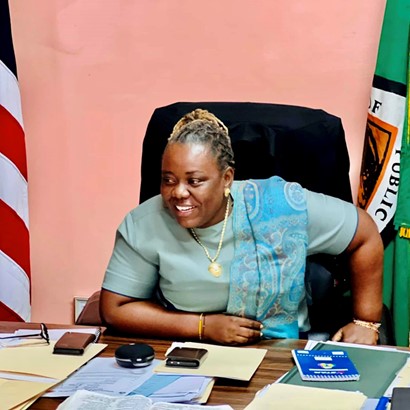
“These projects did not appear overnight,” she stated. “They exist because designs were completed, contracts were signed, and funding arrangements were negotiated.”
Technical Competence and Administrative Leadership
Coker-Collins also addressed what she views as a misunderstanding of ministerial competence. Without personal attacks, she questioned whether administrative leadership without engineering expertise adequately serves a technically complex ministry.
She underscored that road construction is not a purely managerial function but one rooted in engineering precision, hydrological analysis, soil studies, and structural design.
“Highways are not built by slogans,” she remarked. “They are built by engineers applying measurable standards.”
Route Selection and Engineering Justification
Responding to criticism about the chosen alignment through Nimba County, Coker-Collins explained that route selection followed technical and geographic assessments.
“There is no direct highway from Monrovia to Zwedru that bypasses Nimba County,” she clarified. “Engineering studies determined that the Nimba corridor offered the most viable option for national integration and regional trade.”
She stressed that such decisions are governed by topography, cost-efficiency, and long-term economic integration—not political symbolism.
The Broader Question of Continuity
Beyond defending individual projects, Coker-Collins framed the debate as a matter of governance continuity. Infrastructure projects often span multiple administrations, requiring institutional memory and consistent technical stewardship. Dismissing prior progress, she warned, risks eroding public confidence in national development.
“As engineers, we measure progress by signed contracts, secured financing, approved designs, and mobilized equipment,” she said. “Those records are available to anyone willing to examine them.”
She urged current officials to move beyond partisan framing and instead acknowledge the cumulative nature of infrastructure development.
“Nation-building is not about erasing foundations to appear strong,” she concluded. “It is about building responsibly on what has already been laid.”
A Test of Public Accountability
The exchange underscores a broader issue in Liberia’s political environment: how governments account for inherited projects. As road connectivity remains central to trade, agriculture, and regional integration, clarity about timelines and responsibilities carries both economic and political weight.
Whether the debate resolves through technical audit or continued public sparring remains to be seen. For now, Coker-Collins maintains that the Zwedru Road Corridor stands as documented evidence of structured planning—evidence she says speaks louder than rhetoric.


